
The Creative Continuum: How Children Explore & Grow
Creative Exploration in Early Childhood Art
Creative exploration is some of the most developmentally rich work happening in early childhood settings. Mark making, painting, collage, dough work, and loose parts design build fine motor strength, spatial reasoning, language, and social skills — often simultaneously. Yet this work is frequently reduced to scheduled craft time or product-focused activity. When we shift our focus toward open-ended art experiences, where the process matters more than the outcome, something changes in how children engage.
Understanding the stages of creative development helps educators design environments that meet children where they are, ask more intentional questions, and recognize the significant learning already underway. These stages are not linear. Children move through them at their own pace, may revisit earlier stages, and often work across multiple stages at the same time. A child who is scribbling with abandon one day may show careful representational intent the next. Use these stages as a lens for observation, not a ladder to climb.
The Stages of Creative Exploration
 Sensory Discovery
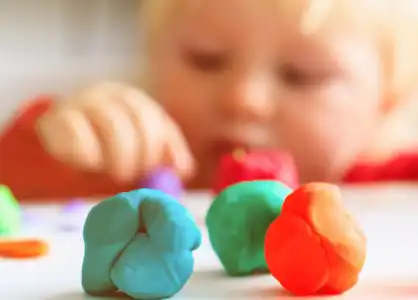
Children in this stage explore through touch, movement, and sensation. They squeeze, smear, splash, and mouth materials. This is not pre-art—it's the foundation of all creative work. When a child presses a finger into soft dough or drags paint across a tray, they are building sensory schemas, cause-and-effect understanding, and the beginnings of intentional action.
Educators can support this stage by offering safe, varied sensory materials such as modeling dough, water, textured papers, and narrating what children are experiencing without redirecting toward a product. Sit nearby, describe their actions, and wonder aloud. The point is exploration, not the outcome.
 Scribbling and Smearing
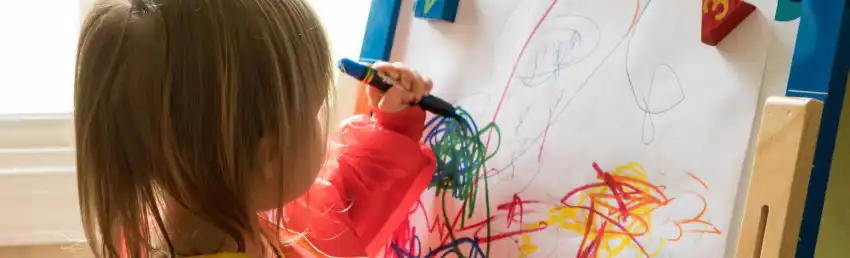
Children discover they can leave a mark, and that the mark follows their hand. This discovery is significant. Scribbling markers back and forth, smearing paint with a full palm, pressing crayons hard to see the color change: these are acts of agency and early scientific inquiry. Children are testing what their bodies can do and what materials will do in response.
 Controlled Marks and Early Design
In this stage, children begin making marks with intention. They draw circles, place collage pieces deliberately, and return to the same spot to refine. They may name their work after finishing, as the story comes after the making. This stage signals growing fine motor control, increased focus, and the beginning of design thinking.
Support this stage by offering varied materials and enough time to work without interruption. Ask open-ended questions such as “tell me about this part,” or “what are you working on?” Display children's work at their eye level to signal that the work matters.
 Representation and Storytelling
Children begin drawing and building things that stand for something in the real world. Circle heads, stick figures, houses, and animals indicate that visual vocabulary is emerging. Art and narrative become intertwined. Children often describe what is happening in their work as they create it, using the art as a way to process and communicate experience.
Listen carefully and document what children say. Introduce shared creative surfaces that invite side-by-side collaboration. Offer materials that connect to children's own lives and communities, and encourage children to revisit and add to work across multiple days.
 Collaboration and Complex Design
Children's work becomes more detailed, more planned, and more social. They set intentions before starting and pursue them with persistence. Collaboration emerges organically — children negotiate placement, build on each other's ideas, and manage conflict around shared materials. A group mural or loose parts project can generate as much communication and problem-solving as any structured lesson.
Step back and let children lead. Your role shifts here from provider to thoughtful co-investigator. Ask questions that push thinking: “How did you get that to stay?” or “What would happen if you tried it the other way?” Support conflict resolution around shared materials. Allow projects to live across days. Children deepen their thinking by returning to unfinished work, and that continuity is worth protecting.
Principles That Work at Every Stage
Regardless of where a child is in their creative development, a few practices consistently elevate the quality of the experience:
- Make it daily: Creative exploration compounds. Consistent access to open-ended art materials builds more than occasional big projects.
- Move from evaluation to observation: Replace “that’s beautiful!” with what you actually notice. Children stay longer and take more risks when they feel genuinely seen.
- Set up the invitation before children arrive: Materials already out signal that this work is expected and valued.
- Offer varied tools and surfaces: Grip strength, sensory preferences, and motor control vary widely. Multiple options mean every child has a genuine way in.
- Honor the process: A child who spends twenty minutes pressing and reshaping dough is doing real cognitive and physical work, whether or not there is anything to display at the end. This is the core distinction between process art and product art: the value lives in the doing, not the display.
When educators understand what children are learning at each stage — and design environments that invite that learning — children stay longer, take more risks, and experience their work as genuinely their own.
Whether you're setting up process art activities for preschool or supporting a child deep in Stage 5 collaboration, the same truth holds: the richest creative learning happens when children are free to follow their own thinking.
That is the goal.
Creative Exploration in Early Childhood Art
Creative exploration is some of the most developmentally rich work happening in early childhood settings. Mark making, painting, collage, dough work, and loose parts design build fine motor strength, spatial reasoning, language, and social skills — often simultaneously. Yet this work is frequently reduced to scheduled craft time or product-focused activity. When we shift our focus toward open-ended art experiences, where the process matters more than the outcome, something changes in how children engage.
Understanding the stages of creative development helps educators design environments that meet children where they are, ask more intentional questions, and recognize the significant learning already underway. These stages are not linear. Children move through them at their own pace, may revisit earlier stages, and often work across multiple stages at the same time. A child who is scribbling with abandon one day may show careful representational intent the next. Use these stages as a lens for observation, not a ladder to climb.
The Stages of Creative Exploration
Sensory Discovery
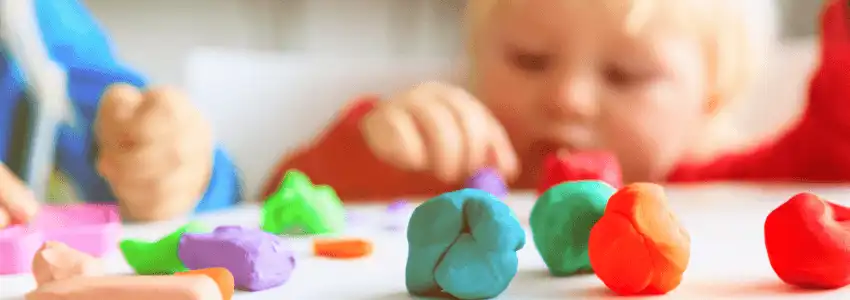
Children in this stage explore through touch, movement, and sensation. They squeeze, smear, splash, and mouth materials. This is not pre-art—it's the foundation of all creative work. When a child presses a finger into soft dough or drags paint across a tray, they are building sensory schemas, cause-and-effect understanding, and the beginnings of intentional action.
Educators can support this stage by offering safe, varied sensory materials such as modeling dough, water, textured papers, and narrating what children are experiencing without redirecting toward a product. Sit nearby, describe their actions, and wonder aloud. The point is exploration, not the outcome.
Scribbling and Smearing
Children discover they can leave a mark, and that the mark follows their hand. This discovery is significant. Scribbling markers back and forth, smearing paint with a full palm, pressing crayons hard to see the color change: these are acts of agency and early scientific inquiry. Children are testing what their bodies can do and what materials will do in response.
Controlled Marks and Early Design
In this stage, children begin making marks with intention. They draw circles, place collage pieces deliberately, and return to the same spot to refine. They may name their work after finishing, as the story comes after the making. This stage signals growing fine motor control, increased focus, and the beginning of design thinking.
Support this stage by offering varied materials and enough time to work without interruption. Ask open-ended questions such as “tell me about this part,” or “what are you working on?” Display children's work at their eye level to signal that the work matters.
Representation and Storytelling
Children begin drawing and building things that stand for something in the real world. Circle heads, stick figures, houses, and animals indicate that visual vocabulary is emerging. Art and narrative become intertwined. Children often describe what is happening in their work as they create it, using the art as a way to process and communicate experience.
Listen carefully and document what children say. Introduce shared creative surfaces that invite side-by-side collaboration. Offer materials that connect to children's own lives and communities, and encourage children to revisit and add to work across multiple days.
Collaboration and Complex Design
Children's work becomes more detailed, more planned, and more social. They set intentions before starting and pursue them with persistence. Collaboration emerges organically — children negotiate placement, build on each other's ideas, and manage conflict around shared materials. A group mural or loose parts project can generate as much communication and problem-solving as any structured lesson.
Step back and let children lead. Your role shifts here from provider to thoughtful co-investigator. Ask questions that push thinking: “How did you get that to stay?” or “What would happen if you tried it the other way?” Support conflict resolution around shared materials. Allow projects to live across days. Children deepen their thinking by returning to unfinished work, and that continuity is worth protecting.
Principles That Work at Every Stage
Regardless of where a child is in their creative development, a few practices consistently elevate the quality of the experience:
- Make it daily: Creative exploration compounds. Consistent access to open-ended art materials builds more than occasional big projects.
- Move from evaluation to observation: Replace “that’s beautiful!” with what you actually notice. Children stay longer and take more risks when they feel genuinely seen.
- Set up the invitation before children arrive: Materials already out signal that this work is expected and valued.
- Offer varied tools and surfaces: Grip strength, sensory preferences, and motor control vary widely. Multiple options mean every child has a genuine way in.
- Honor the process: A child who spends twenty minutes pressing and reshaping dough is doing real cognitive and physical work, whether or not there is anything to display at the end. This is the core distinction between process art and product art: the value lives in the doing, not the display.
When educators understand what children are learning at each stage — and design environments that invite that learning — children stay longer, take more risks, and experience their work as genuinely their own.
Whether you're setting up process art activities for preschool or supporting a child deep in Stage 5 collaboration, the same truth holds: the richest creative learning happens when children are free to follow their own thinking.
That is the goal.

Rachel Waff, Early Learning Environments Lead
Rachel Waff is an Early Learning Environments Lead with Becker’s Education Team.
With a foundation in early childhood special education, Rachel is passionate about empowering educators to deliver high-quality, inclusive learning environments. Guided by a belief in equity and radical inclusion, she partners with educators nationwide to provide professional development, program alignment, and ongoing support that elevates practice and helps every child thrive.
Rachel Waff, Early Learning Environments Lead
Rachel Waff is an Early Learning Environments Lead with Becker’s Education Team.
With a foundation in early childhood special education, Rachel is passionate about empowering educators to deliver high-quality, inclusive learning environments. Guided by a belief in equity and radical inclusion, she partners with educators nationwide to provide professional development, program alignment, and ongoing support that elevates practice and helps every child thrive.